
The platform
The layer that keeps the edge current, safe, and provable.
ByteTrail sits above the fleet, not inside any one stack. It knows what every device carries, simulates and stages each change, verifies the result, and keeps a hashed record. People set policy. The platform does the rest.
How it works
The platform does the legwork. People make the calls.
Every change follows one lifecycle: resolve, plan, simulate, stage, verify, record. Built-in AI agents do the work over typed, auditable skills. The operator approves the plan and closes the campaign.
- ResolveWhich devices carry it
- PlanDrafted from policy
- SimulateRehearsed on the real fleet
- ApproveNamed person, recorded
- Stage and verifyPathfinder, waves, rollback
- CloseReport generated on demand
Handled by the platformHuman decision, recorded with name and time
Any device, any OS, any protocol
Mixed fleets are the normal case at the edge. The platform is built for that, not for a single runtime.
Never trust, always verify
Nothing is assumed present, patched, or healthy. Every claim about a device traces to something the platform observed.
Automation that shows its work
Every automated step lands in the record next to the human decision that authorized it. Trust is earned by evidence, not asked for.
xBOM
Which devices carry that component?
A per-device bill of materials across every layer: OS, applications, firmware, configuration, containers, and certificates. Captured at build, kept current at runtime.
- CoversOS, applications, firmware, configuration, containers, certificates. Dependencies and versions included.
- FormatCycloneDX taxonomy-based, reusable across devices that share a profile.
- Kept currentRefreshed at runtime, not only at install, so drift shows up as drift.
- Used forResolving a disclosure or a vendor release to the exact devices affected. Each device marked affected or clear, rolled up by site and device class.
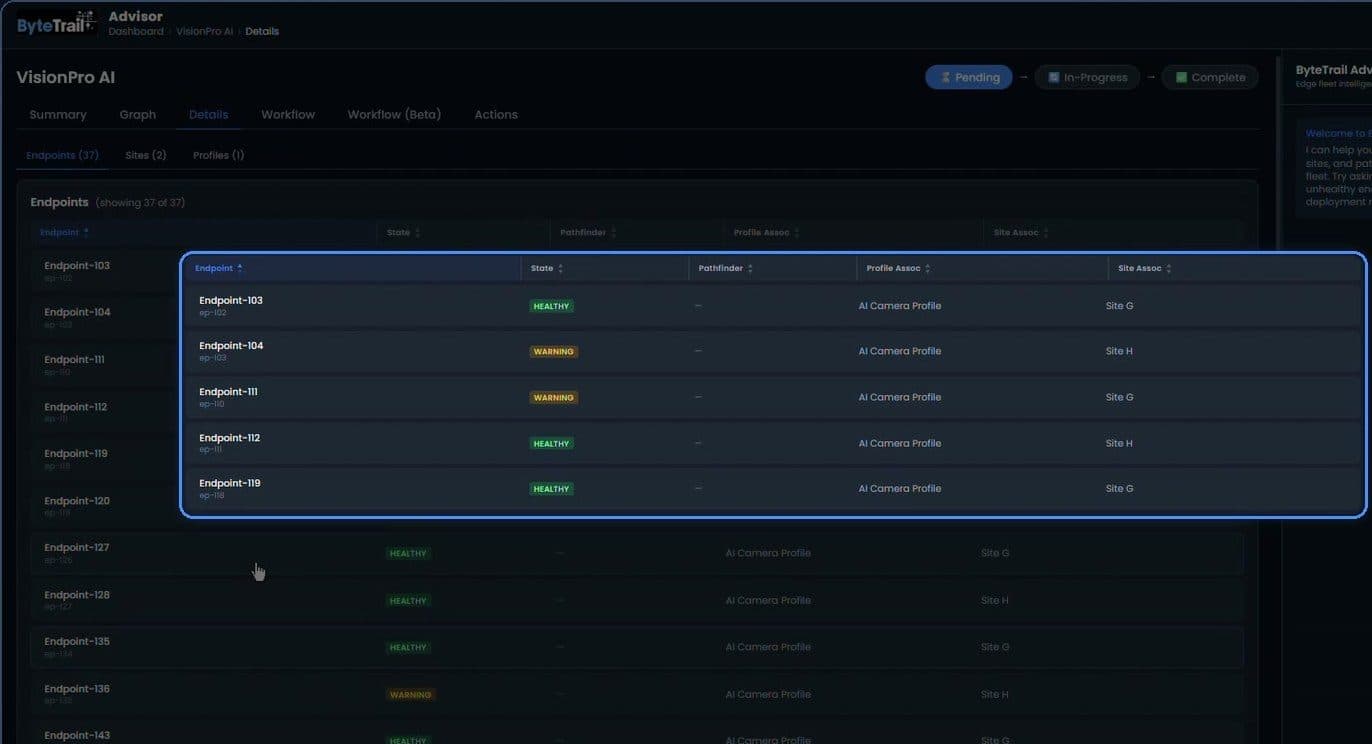
Simulation and staged rollout
Rehearse the whole rollout before a single device changes.
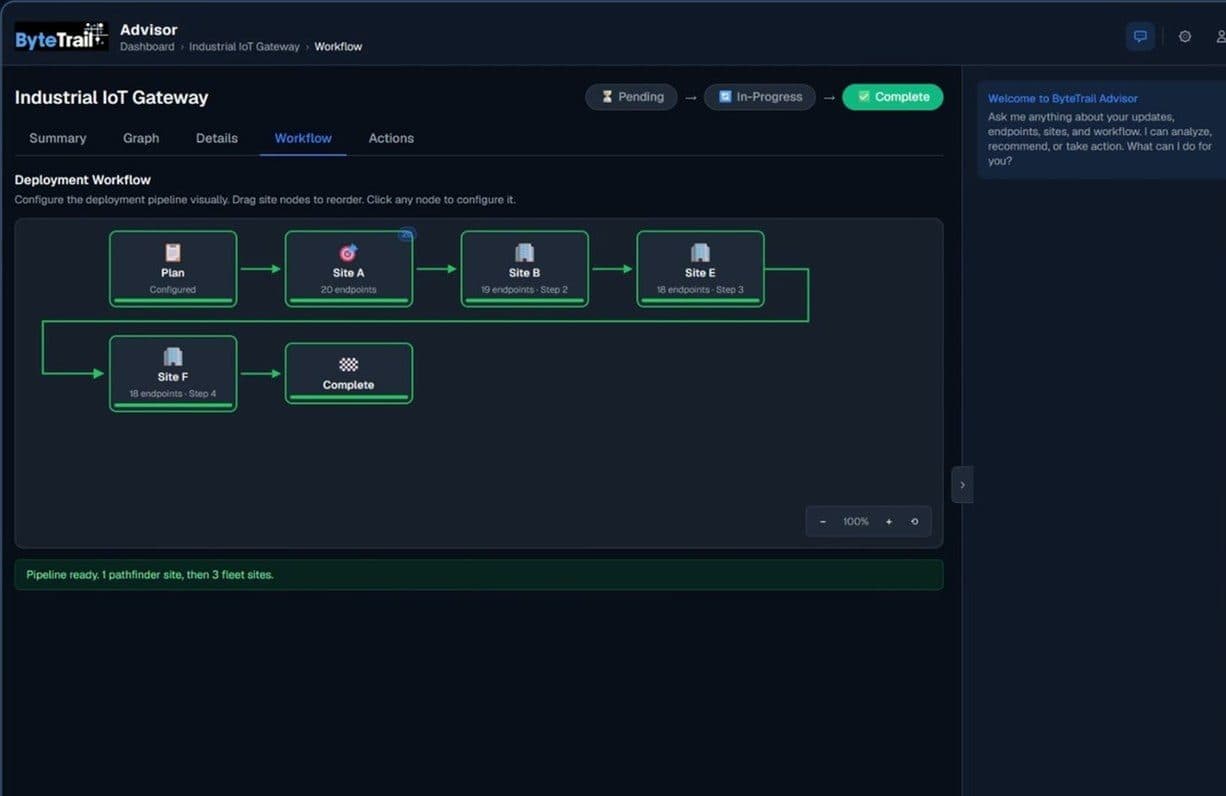
All-at-once deployment, manual updates, and deferral are how outages happen. ByteTrail replaces all three with a sequence that gets safer at each step.
- 1Simulate firstThe entire rollout is simulated against the fleet as it actually is. Sites and endpoints that cannot safely take the change are flagged before anything moves. The operator decides how to handle each one.
- 2Pathfinder first to deployA small, healthy group takes the change first and proves it in production before the rest of the fleet is exposed. Sites carrying warnings cannot lead.
- 3Waves, governed by policyRetry an unreachable device. Stop a service and retry. Roll back to last known good. The rules are set before anything moves.
- 4Verified, then closedEvery endpoint checked. The campaign does not close until the fleet does.
Evidence ledger
A signed system of record, written as the work happens.
Every decision, action, and verification is recorded as it occurs, hashed and chained so it cannot be quietly edited. Reports come from that chain, not from tickets and screenshots.
- RecordsWho did what, and when. Actor on every event. Two timestamps: when it happened and when it was recorded.
- IntegrityEvery event hashed and chained. The report carries the fingerprint of the record it was generated from.
- ScopeDevices affected, resolved from the xBOM with no narrowing applied. Unreachable devices declared, not dropped.
- ExceptionsA failed install is recorded with an owner and a next step, all on the platform. A rollback is itself verified. An exclusion names who, why, and the compensating control.
- OutputsPDF for the record, CSV for the analyst. Both generated from the same chain of events, so they always agree.
- 18:25:09DETECTEDCVE-2024-9012 · VisionPro AI 1.8.0#a41f…
- 18:25:11SCOPEDResolved from xBOM · rolled up by site#7c02… ← a41f
- 18:31:02SIMULATEDRollout rehearsed · 2 endpoints flagged#e9b8… ← 7c02
- 18:34:47APPROVEDM. Okafor · plan v2 · reason recorded#31d5… ← e9b8
- 19:04:12ROLLBACK1 endpoint · automatic · verified#c07a… ← 31d5
- 19:31:55VERIFIEDFleet closed · report generated#f2e6… ← c07a
Hashes shown are illustrative. Each event's hash includes the hash of the event before it.
Coverage
Agent or agentless. Your choice, per device class.
Legacy equipment and modern systems are managed side by side. Teams choose the approach that fits each class of device.
Linux, embedded Windows, RTOS
- Mainstream and customized Linux distributions
- Embedded Windows
- Real-time operating systems
- Bare-metal devices with no OS at all
From servers to sensors
- Edge servers and gateways
- Routers and network gear
- Cameras and IoT devices
- Industrial systems and controllers
Native, not bolted on
- MQTT and gRPC
- SNMP and SSH
- OPC UA and industrial protocols
- More via the integration layer
Hybrid by design
- Lightweight agent where a device can carry one
- Agentless where it cannot
- Both feed the same xBOM and the same ledger
- Nothing requires an agent on every device
Integrations
Extends what you run today.
API and MCP first. Findings go where your team already looks. Evidence goes where your auditors already ask.
- SIEM / detection
- Ticketing
- Secure messaging
- Identity
- Asset inventory
- Reporting / GRC
What “complete” actually means
Three claims you will hear. What is usually missing behind them.
Every vendor says “every device” or “one platform.” Three anonymized teardowns of leading far-edge offerings, names withheld to protect the not-so-innocent, show what a complete answer must include.
Update every device.
“Every” would be fine marketing if it were remotely accurate.
- Firmware only. No application, OS, or container updates.
- No software supply chain visibility. No bill of materials.
- No full-stack vulnerability management.
- No update orchestration to prevent downtime.
- No zero-trust support at the device level.
ByteTrail · complete meansEvery layer a device carries, not just the firmware. OS, applications, firmware, configuration, containers, and certificates in one xBOM.
Industry's most advanced.
High reliance on manual process and network mitigation is not advanced.
- Remediation strategy centers on manual playbooks.
- Network-only security: a crunchy shell around a soft center.
- OT-centric view does not scale to far-edge growth.
- Asserts zero trust with no coverage for OT and ICS devices.
ByteTrail · complete meansFixing the device, not fencing it. Simulation, staged rollout, and automatic rollback replace the playbook.
One platform. Secure software supply chain.
Many, many caveats.
- Supports devices running Linux only.
- OS and limited app updates. No firmware, container, library, or certificate updates.
- Requires an agent on every device.
- No direct visibility of vulnerabilities on deployed devices.
- Three edge protocols. No OPC UA.
ByteTrail · complete meansLinux, embedded Windows, RTOS, and bare metal. Agent or agentless. Native protocols. Evidence for all of it.
Book a demo
See it work on your fleet.
A live walkthrough in the console, scoped to the devices and obligations you actually have.
demo@bytetrail.com877-298-3875Dallas, Texas